Project Type
Countertops and Backsplash in Newport Beach
Slab selection, templating, fabrication and installation, with the seam and edge decisions made before the stone is cut rather than after.
Countertops are the surface people touch every day and the one most often chosen from a two-inch sample in poor light. The material families behave very differently. Engineered quartz is a manufactured slab of ground stone in resin: consistent from slab to slab, non-porous, needs no sealing, and the practical default for a family kitchen. Natural quartzite is genuinely hard and much more etch-resistant than marble while still reading as natural stone. Marble is the material Newport Beach clients ask for most and the one that requires the clearest conversation, because it etches on contact with lemon, wine and vinegar regardless of sealing, and that patina is either the charm or the problem depending on the household. Porcelain and sintered slabs are the newest option, thin, extremely heat and UV stable, and increasingly used where a counter runs out to an outdoor kitchen through a folding door. The mechanics matter as much as the material: templating happens after cabinets are set, the fabricator returns a digital template, and where the seams land, how the edge is profiled, and whether the sink is undermounted are decisions made at template, not at install.
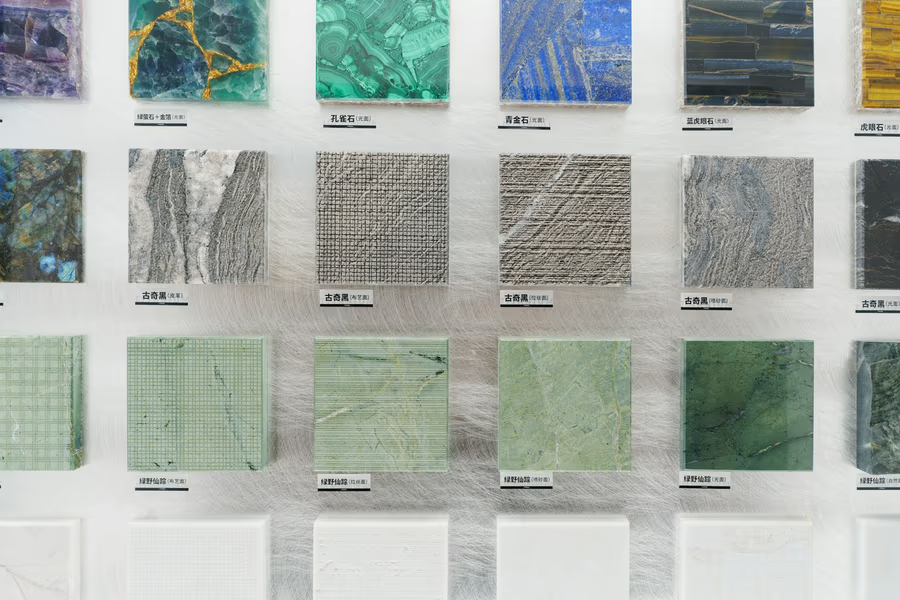
What the scope covers
- Slab viewing at the yard on full slabs rather than sample chips, with the actual slabs tagged and reserved
- Digital templating once cabinets are set and levelled, which is why this step cannot be brought forward
- Seam placement agreed on the drawing, including whether a seam falls at the sink, at a corner, or through a run
- Edge profile selected with the room in mind: a heavy mitred edge reads different from an eased square in a small kitchen
- Cut-outs for undermount sinks, cooktops and any pot filler penetration coordinated with the appliance specifications
- Waterfall ends and bookmatching priced explicitly, because both consume additional slab
- Backsplash set out from a center line so cut tiles land at the ends rather than beside the range
- Sealing and aftercare explained for the material chosen, including what a natural stone will and will not tolerate
To get this priced on your own kitchen, call (949) 791-4160 or use the quote form for a free quote.
Read next
On countertops, specifically
- Quartz or quartzite, and what is the difference?
- They sound alike and are unrelated. Engineered quartz is manufactured, roughly 90 percent ground quartz bound in resin, uniform in pattern, non-porous and maintenance-free. Quartzite is a natural metamorphic stone quarried in slabs, harder than granite, with real variation between slabs and a need for periodic sealing. Quartz is the low-anxiety choice. Quartzite is what people move to when they want natural stone movement but have heard what marble does around lemon juice.
- Will marble be ruined in a working kitchen?
- Not ruined, but it will change. Marble is calcium carbonate, so acids etch it: a dull mark appears where the acid sat, and that is a physical change to the surface rather than a stain sitting on top of it. Sealing slows absorption but does not prevent etching. Honed marble hides etch marks far better than polished. Households that treat the patina as part of the material are happy with marble for decades; households that want the counter to look showroom-new in year five are usually happier in quartzite.
- What does stone cost here?
- Installed, including template and fabrication, entry-level engineered quartz in this market commonly runs about $70 to $95 per square foot, mid-range quartz and granite $90 to $140, quartzite $120 to $200, and marble anywhere from $100 to well past $300 depending on the quarry and the slab. A waterfall end typically adds $1,200 to $3,000 because of the mitre work and the extra slab consumed. A typical Newport Beach kitchen uses 45 to 70 square feet.
- Where will the seams be?
- Wherever the slab size and the run length force them, which is why it is worth discussing rather than discovering. Slabs are finite, commonly around 120 by 65 inches for engineered quartz and variable for natural stone, so any run longer than the slab needs a seam. Good practice puts seams at a sink cut-out or an inside corner where the eye is already interrupted, and away from the middle of an island. On a bookmatched or heavily veined slab, seam placement is a design decision, not just a technical one.
- Does the backsplash have to go to the ceiling?
- No, and both answers are defensible. A standard splash runs from the counter to the underside of the wall cabinets, typically 18 inches. Taking tile or a slab to the ceiling behind the range, or across the whole wall where there are no upper cabinets, is a stronger look and costs more in both material and labor. In coastal houses with open shelving instead of uppers, a full-height slab is often the neater solution because it removes a grout line from a wall that gets splashed.
From the Journal
More on this, written for Newport Beach
Related Projects
Scopes that usually travel together
Kitchen work rarely arrives as a single line item. New cabinetry means new countertops, because the old stone will not survive removal. Opening a wall means rethinking the layout it was constraining. And on a pre-1980 house, the moment the walls are open is the cheapest moment the wiring and pipework will ever be reachable.
Full Kitchen Remodel
Everything out and everything new: cabinetry, surfaces, appliances, lighting, flooring and the wiring and plumbing behind them.
Kitchen Cabinetry
New boxes, refaced fronts, or a full custom build, specified around how the room is really used and what the salt air will do to the finish.
Kitchen Layout Changes
Taking out the wall between the kitchen and the rest of the house, and doing it as a structural job rather than a demolition job.
Kitchen Islands
An island that earns its floor space: sized to the clearances the room can give, and serviced properly if it carries a sink or a cooktop.
Find out what your kitchen costs
Call (949) 791-4160 or use the quote form, and a Newport Beach kitchen company prices the work at no charge.